It's hard to imagine many decent, informed people signing petitions for the thuggish, sleazy, hypocritically prostitution-prosecuting, bullying, business-bashing, campaign-funds-abusing, law-warping, anti-medical-marijuana, disgraced filer-and-withdrawer of groundless cases that is (or once was?) former governor and aspiring comptroller Eliot Spitzer -- and one's limited faith in humanity might almost be redeemed by Roger Stone's July 15 entry suggesting that Spitzer probably hasn't gotten as many signatures as his underlings claim (though Stone, of course, has his own host of issues).
On the bright side, we will all enjoy the (Stone-orchestrated) spectacle of Spitzer running against a former madam for the position.
(And, hey, The Nation was pushing Spitzer for vice president back in the day, so think of what might have been and be grateful we do not live in an even worse alternate universe.)

TODD SEAVEY author of Libertarianism for Beginners and writer of/speaker about many other things
Tuesday, July 16, 2013

Thursday, July 11, 2013
My Terminator Pitch
I don’t mean to suggest that I think the guy who wrote Drive Angry isn’t up to the task, but
this is what I’d do.
As I've said before (but I'll say it shorter each time), the
only new Terminator worth doing would have a line like "It's 2015 A.D.,
and after countless time travel missions we finally achieved a timeline with no
nuclear war and no Terminators -- I'm the only one who remembers how horrible
things might have been...and somehow that's why, in this pleasant world of cat
videos, social networking, and algorithmic online shopping, the drones and
military robots have begun tracking me. My name is John Connor."
But in the meantime, let’s do a debate about Bitcoin (and
related matters) at next month’s Dionysium in Williamsburg. More soon.
Monday, July 1, 2013
DIONYSIUM 7/9: Sex Roles: More Biology or Society?

 Are even the most bizarre gendered actions undertaken by the
human race -- say, men wanting to smash foes like Superman smashing Zod, or women
flocking to the defense of Aaron Hernandez and the surviving Boston bomber -- just
the playing out of arbitrary social codes?
Could these patterns be unlearned, or are they just evidence of an
intractably gendered human biology? Find out at last!
Are even the most bizarre gendered actions undertaken by the
human race -- say, men wanting to smash foes like Superman smashing Zod, or women
flocking to the defense of Aaron Hernandez and the surviving Boston bomber -- just
the playing out of arbitrary social codes?
Could these patterns be unlearned, or are they just evidence of an
intractably gendered human biology? Find out at last!
The Dionysium presents a debate next week, Tue., July
9th (8pm) on
"Blurred Lines: Are Sex Roles Created More by
Biology or Society?"
with:
Biology: Diana Fleischman, Ph.D., senior lecturer in
evolutionary psychology at the University of Portsmouth (and vegan blogger at
http://Sentientist.org)
VS.
Society: Kelly Ann Beavers, Ph.D. candidate in
sociology/urban studies -- sometimes studying Williamsburg (she's also a yoga
instructor and aspiring underwear model)
And because Beavers is in the band Bells and Hunters (http://bellsandhunters.bandcamp.com/), we will
also hear a song -- possibly about love or gender roles.
Todd Seavey moderates in typically-sensitive fashion,
with loads of audience Q&A.
It's all Tue., July 9 (8pm), at the Muchmore's
performance space/bar in Williamsburg, ground floor of 2 Havemeyer St.
(corner of N. 9th St.), just three blocks east of the easily-reached first L
stop into Brooklyn, Bedford Ave.
Thursday, June 27, 2013
Getting It Out of Our Systems (and the Systems Out of Us)
Gay activists are pretty happy with the Supreme Court’s decisions this week, but it was also a good
week for the multilayered federalist system.
When America’s in doubt (and especially, to my mind, when
even some libertarians are a bit
torn about how to handle things), punting to the states at least avoids
everyone having to fight viciously for one-size-fits-all,
centralized victory. Even when it
means Arizona enforcing immigration regs that may soon be obsolete or
California making extra-onerous climate regs, at least the state-by-state
method allows for some variation and experimentation (though individual property
rights remain my favorite sweeping, all-purpose systems-hack, of course).
Indeed, I very much look forward to (repeatedly-arrested but
unbowed) libertarian activist Adam
Kokesh’s planned fifty-state-capitols July
4 protests calling for all fifty states to secede simultaneously from Washington,
DC (replacing his less-ambitious, but potentially more-dangerous, earlier
plan for an armed DC pro-gun march that day).
Diversity is strength, after all, and the mass-secession plan has the
Constitution and history on its side – instead of just anarchist/libertarian
theories that not all states or citizens would necessarily like.
Secession might prove the path of least resistance for those
who want to maximize resistance, so to speak – and, hey, it’s not like only
pro-slavery states can secede. Consider
the beneficial break-up of the USSR,
which may not have been as unlike us as we used to think.
•••
I’m happy to see the feds be gender-neutral on marriage and
at the same time to let states (outside the Ninth Circuit, presumably) keep
wrestling with the issue – though I keep hoping social conservatives will just
give up, I admit, since I don’t want these issues to keep splitting the
free-market portion of the electorate.
As the print record will show, I had hoped the rise of
(somewhat “conservative”) gay commitment ceremonies in the 90s might mollify
the social conservatives, then hoped the early-00s knocking down of sodomy laws
by the Supreme Court might get conservatives to give up on that stuff and just
stay focused on econ, then hoped some compromise would be reached on gay
marriage...though people keep fighting this battle, plainly, alienating various
potential GOP voters in the process.
(Even very-Christian Rand
Paul would pretty clearly like the issue to stay at the state level so he doesn’t have to touch it, and his aged dad was moving that way on the
issue by the time of his final presidential campaign, despite some
very-nearly-unlibertarian deviations on the issue earlier in his career. I watch Rand Paul’s delicate
libertarian/GOP/mainstream balancing act with almost as much tension as I did Nik Wallenda’s dizzying tetherless
tightrope walk across the Grand Canyon.)
•••
Being radical enough to get something big accomplished while
also seeming moderate enough not to be marginalized is a tricky game that
recurs in many contexts: As befits the climactic entry of this blog’s “Month of Systems,” I’m really talking
about the challenge of working within the system to drastically alter the
system.
Whether the topic is constitutionalism, philosophy, or
conflict-resolution in general, everyone tends to sense that appearing to be in
the “neutral” position is an easy route to victory-by-default (though any
pretense of neutrality is usually a bit phony).
I was reminded of two thinkers I like who manage to sound
pragmatic/moderate and still have very radical implications, David Stockman and Jonathan Haidt, when I saw the former speak at a Reason event and
the latter in the audience for the talk, earlier this week.
And here’s hoping that a
feminist out there trusts me to be neutral-despite-some-radical-notions
when I moderate my planned July 9 onstage
Dionysium debate on evolutionary psychology (and the question of whether
gender roles are more determined by nature or nurture). We have our ev-psych/“nature” debater (Diana Fleischman) and will need to
finalize her feminist foe very soon, so by all means contact me if you want to be that feminist (we’re
very civil, really – civility and humor are also good defaults, after
all).
After that biological-systems-hacking debate (so to speak), August 12 will bring our econ-hacking
debate on Bitcoin, so join us (possibly even volunteering to be a debater)
for that, too.
Every Dionysium debate is a potential shock to the system,
though.
Wednesday, June 26, 2013
BOOK NOTE: “Crisis on Multiple Earths, Vol. 6” and “Godzilla: The Half-Century War”

•Long, oft-told story short: comic book superheroes (and
some sci-fi characters) have undergone so many revisions over the past eighty
years that the writers eventually, inevitably, want to do stories in which
different versions of the same characters meet each other. Thus, for example, DC Comics’ periodic
“Crisis” stories in which characters hop universes to meet, say, the World War
II-era versions of themselves.
DC just put out a sixth (and probably second-to-last) volume
of Crisis
on Multiple Earths stories of that sort that they did prior to the big
1985 team-up in which they smooshed all their fictional universes into one for
simplicity (at least for a couple decades).
Stories like these will likely have at least a little
influence on the tone of eventual Justice League movies, though for now it
sounds far more likely DC’s parent company, Warner Bros., will focus on Man of Steel sequels.
These stories will also be echoed in an explicitly
meta-fictional fashion by my favorite comics writer, Grant Morrison, in his
upcoming Multiversity miniseries,
riffing on the rarely-mentioned but intriguing idea that some DC Comics
universes are considered “fiction” (and read about in comics) by the
inhabitants of other universes.
•As befits this blog’s “Month of Systems,” it’s all evidence
that the nerd mind specifically, and the human mind generally, likes to weave
sufficiently complex things into more tidy and elegant systems, for good or
ill.
You’d think Godzilla – being a big, dumb, lumbering
reptile-monster instead of a confluence of alternate realities – would be less
prone to such systematizing efforts (Destroy
All Monsters! and the fragile ecosystem of Monster Island notwithstanding),
but in the beautifully-drawn (and now anthologized) comic book Godzilla:
The Half-Century War by James Stokoe, you can see a bit of the
systematizing nerd-impulse at work.
Stokoe takes the (over) half-century of depictions of one of
the most famous monsters in movie history and asks what it might be like if the
creature had actually lived that long and been tracked (and periodically
fought) all that time by two determined, stoic military men. The result is great balance between the tone
of the movies I loved as a four year-old and the bittersweet tone of much manga
and anime.
You might read it as prep for next month’s heavily
Japanese-influenced, robots-vs.-giant-monsters movie by Guillermo Del Toro, Pacific Rim.
Tuesday, June 25, 2013
BOOK NOTE: “Why Coolidge Matters” by Charles Johnson
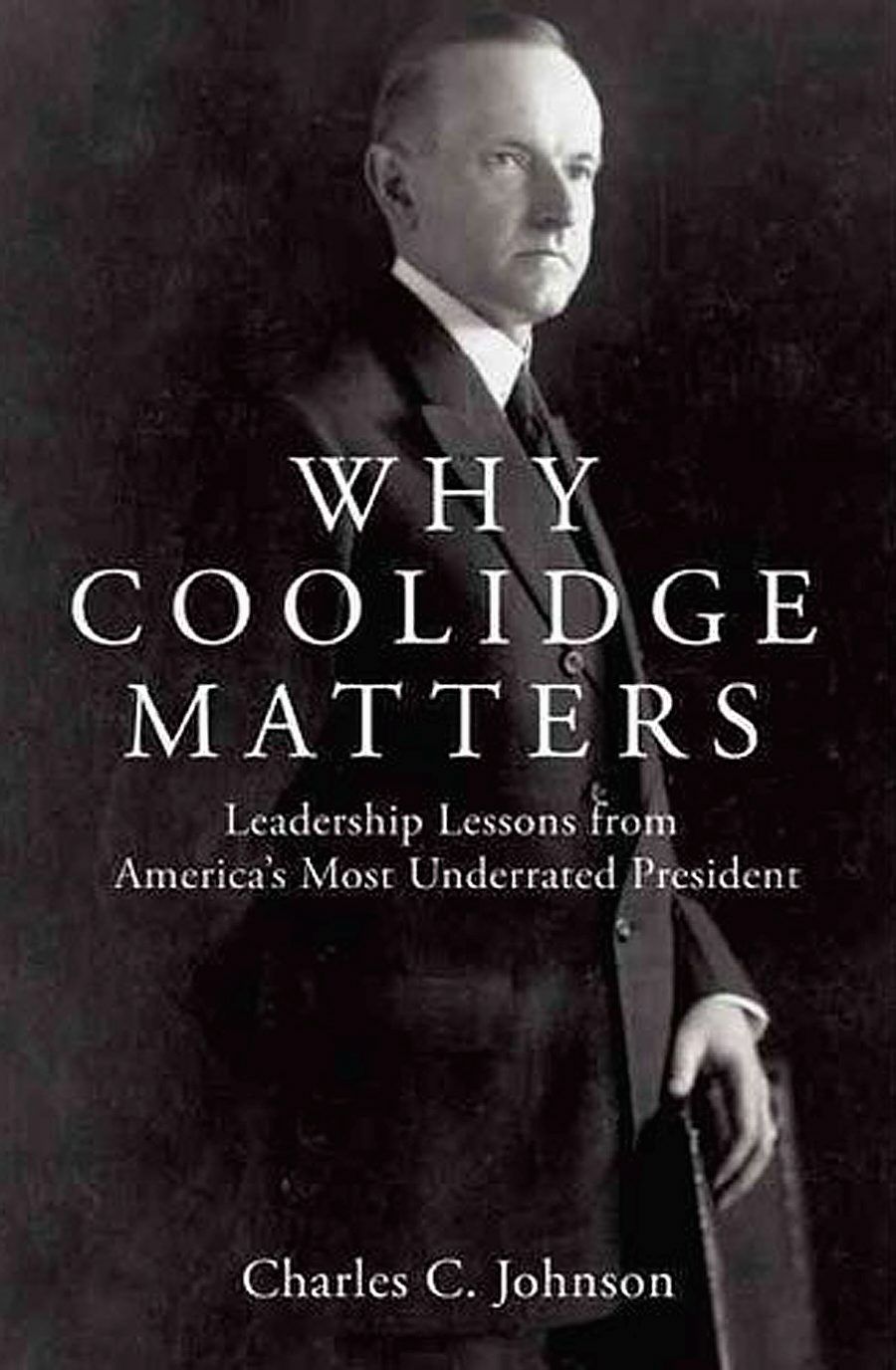
I’m off to a Reason-organized talk by David Stockman
shortly. It’s interesting how much his
stock has risen, perhaps especially among conservatives, as he continues the
economic-doom talk that got him denounced in the Reagan years for failure to be
a team player. (Perhaps one day it will
also be more acceptable among conservatives to favor increased immigration, and
Reason has something to say about that, too, or at least Shikha
Sood Dalmia draws some lessons from Canada.)
Charles Johnson (who might disagree with me, Dalmia, and for
that matter Reagan on immigration) thinks Calvin Coolidge is due for a favorable
reevaluation, too (he’s already my favorite president, not that I’m saying
there should be a government at all).
When not researching nefarious living
politicians, Johnson (a young Publius Fellow and one of my fellow Novak
Fellows) found time to write Why
Coolidge Matters: Leadership Lessons from America’s Most Underrated President,
and he makes a great case that both Coolidge’s many detractors and his
libertarian defenders tend to mistake his very active – but laissez-faire –
leadership for a sleepy, do-nothing style.
Coolidge here comes off as a tough decision-maker, albeit
one whose tendency to pick non-regulatory and non-tax solutions looked like
neglect to many intellectuals of his day and, soon, to the Progressive
historians who have since shaped how we see Coolidge.
To many, he is mainly remembered as the president before
Hoover and thus, presumably, one more person to blame for the subsequent
Depression – but whereas the Depression may have been slightly exacerbated by
Hoover and greatly exacerbated by FDR (conventional wisdom notwithstanding),
it’s worth noting that the 1920s prosperity Coolidge oversaw increased American
living standards by about half, with a substantial portion of those gains
withstanding even the subsequent Crash.
Coolidge as seen here should be of interest not only to
libertarians but to fusionist conservatives, since Coolidge blends even more
seamlessly than Reagan (who was influenced by Coolidge) a belief in
laissez-faire and a humbly-religious belief that America owed its prosperity
and success to a traditional moral foundation.
Progressives (if they’re open-minded!) might be intrigued by
the fact that Coolidge, as a Vermonter and then governor of Massachusetts,
before becoming vice president and president, was very much a Progressive in
the early-twentieth-century mold – but one who quickly became disillusioned
with the gap between legislative intentions and real-world outcomes. He often complained that America had begun
legislating faster than it could manage, predict, or understand the fallout of
law-making.
I can only imagine Coolidge would be as
chronically-horrified as Ron Paul if he saw Congress in action today with its
massive, unread bills (including, admittedly, immigration reform).
Here are ten bits from Why
Coolidge Matters that particularly caught my eye:
Monday, June 24, 2013
Don’t Look Down While Using the System, Man! (plus Troll Stroll photos)
Fittingly, as this blog’s “Month of Systems” reaches its
final week and America waits to see if marriage will be legally redefined, I find myself looking to recruit someone to
argue the “nurture” side of a July 9 debate on whether sex roles are
primarily a product of nature or nurture (arguing “nature” will be evolutionary
psychology professor and fine human specimen Diana Fleischman).
I may have a lead
on a transgender anthropologist interested in arguing the “nurture” side (as
you might imagine), but one hates to count one’s chicks, etc.
Biology and mainstream culture both tend to be treated as
straitjackets in some debates of this sort -- but you might argue that
science/biology makes both mainstream culture and more subjective forms of
radicalism look like shifting and arbitrary things by comparison.
I blogged in the previous entry, from my own skeptical
perspective, about the mystical/spiritual outlook being at times a form of
open-mindedness. Of course, the main
problem with views adopted from gut instinct or aesthetic preference is that
they will tend to be arbitrary and nonetheless to get asserted as if descriptive of external
reality.
And so, for one thing, we find ourselves awaiting word from
the Supreme Court this week about whether gay people can marry, largely because
some people think God says they can’t -- though that’s admittedly making a long
story I’m not terribly interested in short, etc.
But I picked up a couple religion-inflected free magazines
at a Columbia conference on marriage where my friend Dawn Eden spoke -- an
issue each of Touchstone
(January/February 2013) and the conservative Intercollegiate Studies
Institute’s mostly-sane Intercollegiate
Review (Spring 2013) -- and they’re both reminders that mainstream religious
claims, just like seemingly-odd mystical or paranormal claims, are at least
usually footnotes to a much larger system that at least looks more harmonious
taken as a whole than it does when examined only for its oddest or most
offensive footnotes.
Further, both magazines are conscious of defending an entire
worldview against rivals such as liberalism -- and that can have some
interesting side effects such as a Touchstone article contrasting the optimism
of C.S. Lewis’s sci-fi novels (less familiar, perhaps, than his Narnia
fantasies) and H.P. Lovercraft’s horror.
As I’d noticed myself, there are many similarities in tone
and approach between the two -- lots of ominous intrusions from
barely-comprehensible higher dimensions in a very early-twentieth-century style
-- but in the end Lewis thinks the universe is structured this way because
someone up there likes you, whereas Lovecraft’s universe is an unfeeling,
almost sociopathic void in which you don’t matter. In the era of eugenics’ greatest popularity,
Lovecraft was both an atheist and a bit of a fascist, and not too happy about
either role. (Not everyone is a
well-adjusted skeptic and biotech enthusiast like me.)
But the ultimately arbitrary (or at least
psychology-dependent) nature of spiritual claims can lead to much weirder
places than overall optimism, pessimism, or limited conceptions about the
nature of tradition.
I only just learned that an online acquaintance of mine --
when not being an underwear model, rock singer, libertarian, and yoga
instructor -- is also a
Thursday, June 20, 2013
BOOK NOTE: Freeman magazine and spirituality
•A utilitarian and a
Unitarian walk into a bar – at least, that’s how many of my evenings begin
lately, and tonight the bar/performance space in question is the Waltz-Astoria (close to the
Astoria/Ditmars Blvd. N/Q stop), where Vito Racanelli will be one of the
readers (join us, if you like). Among
other things, Vito has written about being a kid in Italy at a time of
terrorist attacks.
The show may be
interrupted by cell phones, unless the Waltz-Astoria (and other venues) adopt
this new phone-use-preventing
beer glass (h/t Justin Shubow). But
I’m sure I’d enjoy it anyway – and perhaps use the evening to recruit a
feminist to argue the “nurture” side of the debate I’ll moderate on July 9
about whether gender roles are mostly a product of nature or not (or YOU could
volunteer – let me know).
•Tonight and July 9 will presumably be more highbrow
than my other main cultural plans for the summer, starting with seeing the
monsters-vs.-robots movie Pacific Rim
in mid-July (having just seen – and greatly enjoyed – both Man of Steel and World War Z, it’ll be like I’m seeing
the apocalypse canceled three times in a row).
That outing will
probably be followed by seeing three, count ’em three, comic book-based movies
in a row: RED 2 (with sexy gun-toting
Helen Mirren), Wolverine, and Kick-Ass 2.
•Back on a more
brainy note: in addition to recruiting the aforementioned feminist, I should
recruit a libertarian to argue the merits of recently-troubled e-currency
Bitcoin (on August 12), alongside left-wing Bitcoin enthusiast Sander
Hicks, against two appropriate Bitcoin-detractors.
Someone along the lines
of (busy) Jeffrey Tucker would be great.
He wrote a basic intro to Bitcoin for the Freeman (magazine of the Foundation for Economic Education), with
other recent issues tackling important freedom-related topics such as education
and anarchism. I love the Freeman so much I left a copy on the
magazine rack at the Brown Bookstore last month, right near a copy of Lacanian Ink and admittedly obscuring a
copy of Brooklyn’s own n+1.
Always subverting,
always educating.
•One curious thing
about Freeman is that, in a
libertarian movement overwhelmingly focused on earthly matters like government
spending cuts and deregulation (my two favorite things), the magazine has
occasionally over the decades touched on spiritual matters.
It’s subtle and
unlikely to offend even the most gung-ho of atheists, but Freeman has long augmented its Rand and Jefferson quotes with the
occasional Bible quote, and not in an argument-from-authority way, either.
Nor even a
conventionally-Christian way: Foundation for Economic Education founder Leonard
Read apparently was a devotee of meditation. Brian Doherty has chronicled how mid-century
LSD culture likely influenced Read’s all-things-are-connected approach to
meditation, which in turn likely influenced his famous unplanned-connections-in-the-marketplace
essay “I, Pencil,” which in turn influenced the rhetoric of pro-market
economist Milton Friedman.
So maybe everything is connected, from acid-droppers to
Ronald Reagan (on that note, maybe we should pause to watch this real footage of a 1950s
housewife on LSD).
•It’s sort of
fitting, then, that still-new Freeman
editor Max Borders (the friend whose book Superwealth
I blogged
about last time) has written about libertarianism needing a dose of
“mysticism,” by which he means a frank admission that since we (more than other
political factions) admit we cannot predict or plan what innovations the future
will bring, we ought to approach the unfolding process of civilization with
a fair amount of wonder, humility, and
hope. (Complex systems are often unpredictable,
as has been noted repeatedly during my blog’s “Month of Systems.”)
Truth be told, I had
something similar in mind when I jokingly distributed flyers for a “Church of
the Spontaneous Order” two decades ago at the Mises
Monday, June 17, 2013
BOOK NOTE: “Superwealth” by Max Borders (plus the Man of Steel and a dash of punk)

For all its simplicity and flashiness, I for one loved Man of Steel and felt as if it resembled
the 1930s Max Fleischer cartoons in its unapologetic emphasis on the visual and
the large-scale (very operatic). It’s
really the only major film I’ve so
far seen that made me glad I paid for IMAX and 3D. And it’s not without emotional or moral
gravitas: You will FEEL before Zod. And if you’re a libertarian, you’ll like a
couple timely surveillance jokes, too.
If you’re a libertarian who likes Superman-ish metaphors and
wrote a book defending super-wealthy entrepreneurs, you might well be my friend
Max Borders, whose Superwealth
has a superheroic-looking figure sporting a dollar sign on its cover, sure to
delight Ayn Rand fans.
But Max is a down-to-earth, humane fellow not just
interested in defending the tough-as-nails qualities of mega-CEOs. He jumps back and forth between examining a
few of those and a few likable, ordinary mortals such as his own great-grandmother,
who eked out a living during the Depression in North Carolina (a state full of
interesting characters) and lived to be 104, showing in the process that the psychological
traits leading to success are recognizable, distinct, and valuable regardless
of one’s initial economic circumstances.
We aren’t afraid to say athletes might start with some
natural (or early-developmental) differences that set them apart from the rest
of us, but it’s unfashionable to call adept entrepreneurs natural talents – or
even to admit how hard they drive themselves – since that risks undermining
envious, egalitarian, and compassionate narratives alike.
Yet even arch-capitalist Adam Smith – with what to me seems
like a very appropriate and very modern mixture of awe, thanks, worry, and pity
– wrote in Theory of Moral Sentiments
that there’s something a bit miserly and abnormal about the way the very rich
drive themselves to achieve profit – with the rest of us largely benefiting
from their heroic mania. (Maybe leftists
would find it easier to view money-making as a weird yet creative activity if
they read this article, pointed out by Emily Richards, about rich
punk musicians.)
In much the same way that I’ve occasionally noted my own
still-living grandmother as a neat yardstick of how much things can change in a
lifetime, Max notes that despite all the despairing and declinist talk you
hear, his great-grandmother saw the proliferation of everything from tractors
and electric milkers to refrigerators, indoor plumbing, and colonoscopies
during her lifetime, all the while hearing that “the poor get poorer.”
Mama Borders lived a noble, hard-working, and non-famous
life while professional whiners like Barbara Ehrenreich explain how we’re all
economically doomed because she didn’t fully enjoy the menial jobs she took on
a journalistic whim.
There are some basic attitudes toward wealth-creation that
people on both right and left seem to share: Max notes how many creative
companies seem to share the view that every employee should function with some
degree of autonomy and be rewarded as an individual for innovation.
By contrast, when it comes to the big-picture economic
models, leftists keep saying things that suggest they see wealth as something
that happens automatically and effortlessly, making the rich and entrepreneurs
creatures easy to, well, milk. Max
quotes Obama advisor Jared Bernstein saying “there’s no reason to expect people
to respond to higher tax rates by working less.
That is, they could just as easily decide to work harder to make up the
loss in their after-tax income.”
So, hey, stick it to ’em some more. (Adding to the
Friday, June 14, 2013
BOOK NOTE: Jeremy Scahill’s “Dirty Wars” and Critical Review
I blogged yesterday about the beautiful graphic novel Strange Attractors, with its meditations
on complex, barely-predictable systems.
The journal Critical Review
(vol. 24, issue 3) deals in its latest issue with similar questions, featuring
essays reacting to the late-90s increase in interest in “systems analysis,” the
attempt (initially in foreign policy) to acknowledge that prediction gets far
more difficult when there are overlapping simultaneous forces in play and you
aren’t really sure which ones matter most.
That may seem intuitively obvious to most people, but the
academics (and ideologues) who normally study such things -- trying to predict
wars and coups and the like -- love the illusions of control, predictability,
and simplicity that seem to give them at least a fighting chance of making
useful models of the world.
Of course, we don’t want to just throw our hands up and
despair, either. So, it’s unclear quite
how to proceed. As in the hard sciences,
the answer might be forthrightly making more testable predictions (analogous to
holding pundits accountable for their errors, which rarely happens).
While the political science professors wrestle with all
those abstractions, though, I would suggest seeing leftist war reporter Jeremy
Scahill’s ominous, dramatic documentary Dirty Wars (spun off of his recent book and articles on the topic, but that link takes you to the film trailer) as a
simple, concrete, real-world illustration of how complexity leads to greater
tension between desperation for control
and the inevitability of tragic error. Scahill just went and talked to the villagers
and survivors who the mainstream press never dared trek over the hills to
locate. The result is very eye-opening.
Seeing the film might be a good way for some of my more
neoconservative acquaintances here in New York City to spend Flag Day, in fact,
since it’s a reminder how many variables are at play when you start down the
road of running covert ops in numerous nations (without declaring war) -- much
messier than just settling the simplified two-second debate about whether
America is good and its major foes bad.
In New York City, you can see it at IFC and Lincoln Plaza,
and its glimpse of the survivors of U.S. raids overseas -- and a visit with a
warlord in Somalia who we’re paying to do our dirty work -- might just change
your whole worldview, whether you’re a conservative hawk or a loyal Obama
Democrat. But then, I’ve grown
anarcho-capitalist enough to think even minarchism, with its (over)emphasis on
the state’s “legitimate” role in policing and military matters, might be
granting far too much to the state.
Lest I sound all lefty, though, let me emphasize the capitalist part in that
anarcho-capitalist formulation by blogging about Max Borders’ book Superwealth in my next entry.
Thursday, June 13, 2013
BOOK NOTE: “Strange Attractors” by Charles Soule and Greg Scott

Just the other night, I saw my mathematician friend Charles
Blake talk about the impossibility of time travel as part of a panel at the
Empiricist League -- and recruited decreasingly-Marxist activist Sander Hicks
to be one of the Dionysium’s speakers on the topic of Bitcoin on August 12 --
so I was in the perfect mood to read a
strange story about math.
The graphic novel Strange
Attractors by Charles Soule and Greg Scott is perfectly timed: It
depicts secretive mathematicians who can predict human behavior with such
reliability that they take it upon themselves to save complex systems such as
New York City itself from chaos, including bomb-making terrorists.
These mathematicians aren’t creepy government agents, though.
(And I type that while hearing, for a few weeks now, the
steady, very quiet thrum of what are likely, a friend in the military agrees,
permanent drones over the Upper East Side -- which I’m relieved to say I’m not
the only New Yorker to have noticed in the wake of the Boston bombing, though I
may have been one of the lucky few to
notice the night of their deployment, or at least to have seen a larger, more
conventional helicopter flying around here, oddly low, at about 4am one night
several weeks ago, after which a much quieter rotor noise has never fully
stopped, impossible though it is to hear when there’s substantial street noise. All this was just a few months after a couple
speeches by Bloomberg saying drones would soon be adding to our safety in the
way street cameras do, though I thought little of his comments at the time.)
The mathematician main characters are instead Columbia
academics, an elderly mentor and a young acolyte, the latter a Gen X
alternative rock fan after my own heart, proud of his Talking Heads collection
and familiarity with some rising Brooklyn bands.
Despite the presumptuous main conceit of the comic -- that
these eccentric professors can save the City from disaster with tiny,
random-seeming acts such as musical performances and strategic graffiti -- Soule
does a great, dare I say it Hayekian, job of capturing how complex the City is
and how hopeless would be the task of any real-world central planner trying to
coordinate it all (but how exhilarating it is to be a part of it all
nonetheless).
Our mathematician heroes function less like Asimov’s planner
Harry Seldon (one of Paul Krugman’s favorite characters) and more like
unwitting chaos-theory butterflies, occasionally nudging things in a better
direction but barely understanding how. Soule
has also written the ecology-themed Swamp
Thing for DC Comics -- and, after all, one can appreciate the fragile
complexity of both markets and ecosystems, though they so rarely get spoken of
in the same breath. There’s nothing
wrong with Superman and his ilk -- I’ll see the Sunday 6:45pm show of Man of Steel -- but do check out Strange Attractors for something a bit
more grown-up and artful.
Zack Snyder directing Man
of Steel reportedly meant Darren Aronofsky not directing it -- just as
Aronofsky’s decision to direct Black Swan stopped him from directing the
impending RoboCop remake, for good or
ill. But those hankering to see
something sci-fi-ish from Aronofsky can take heart that the
fifteenth-anniversary edition of his film Pi is out -- and the film probably had more than a little influence
on Strange Attractors, so maybe you
could get them as companion pieces. (Oddly enough, come to think of it, if they ever made a movie out of Nassim Taleb’s totally unrelated, math-inspired book Black Swan, Aronofsky might still be the man for the job.)
•••
It’s often been remarked, amidst the recent overlapping
controversies over spying and data-mining, that one reason there isn’t even more outrage over
Tuesday, June 11, 2013
Top 10 Obama Scandals to Discuss at Tonight’s Debate
I tend to indict the system rather than the man (in keeping
with this blog’s “Month of Systems”), but here are ten current Obama scandals
we should touch on at tonight’s
9:30 DIONYSIUM debate at Muchmore’s about whether to impeach him, with
emphasis on what are arguably the victims:
10. The man got a Nobel Peace Prize before presiding over
another five years of the war in Afghanistan.
9. It’s unclear we were told the truth about events during
the al Qaeda attacks in Benghazi that killed the U.S. ambassador to Libya and others (as Rand Paul may end up
reminding Hillary Clinton in the 2016 presidential race, in the ultimate
semi-libertarian vs. semi-Progressive showdown).
8. The Associated
Press, Antiwar.com, and others have found themselves spied
on thanks to the Department of Justice, while Fox News’s James Rosen was snooped on by the FBI (all of it suggesting to
Sen. Ted Cruz that Obama dislikes the First, Second, Fourth, and Fifth
Amendments, despite being a constitutional law professor).
7. Bradley Manning
is now on trial years after first being arrested for spilling Department of
Defense secrets about collateral deaths to WikiLeaks.
6. Tea Party groups
have gotten special scrutiny from the IRS.
5. As Nation-affiliated
reporter and Dirty Wars author/screenwriter
Jeremy Scahill has documented, the U.S. government kills many innocents and maybe-innocents caught in its
drone strikes.
4. Obama has doubled the combined number from all prior
administrations of lawsuits against whistleblowers.
3. If CIA whistleblower Eric
Snowden is correct, we’re all being spied on every time we use phones,
e-mail, or website, in an unprecedented government data-mining operation
including the program called Prism.
2. Gitmo still
being open over four years after Obama’s election, and wracked by a massive
hunger strike, must frustrate some Democrat voters, I’d think (though I’ve
always said it’s only 160 or so guys, for now).
1. More troubling is the fact that despite a decade of al
Qaeda being the great menace on the horizon, we appear now to be allied with it
in Syria. Anyone but Russia, basically -- not that I
dismiss realpolitik.
And I will remain neutral as I moderate tonight’s debate (please join us), recognizing the
very real tensions between transparency and the need for secrecy, government
overreach and real terrorist dangers, American safety and the risk of
imperialism, tradition and change, heroism and martyr complexes, honor and
rebellion, uncertainty and inquiry, proper procedure and subversion, defense and
anarchy.
Monday, June 10, 2013
Dionysium, Tue. 6/11: Should Obama be impeached?

"Should Obama Be Impeached?"
That's the question debated by human rights lawyer Howard
Yourow ("Yes") and consultant James Kaplan
("No"), with implacably neutral moderator Todd Seavey, at the
next Dionysium ( https://www.facebook.com/events/114132925428556/
).
Tuesday (not Monday!), June 11th, 9:30pm in the Muchmore's
performance space, with abundant beer for sale (and sofas) for facilitating thorough
audience Q&A on this very open-ended topic, at a pivotal time when
people at varied points on the political spectrum see government credibility
faltering.
Easily-visited Muchmore's is at 2 Havemeyer St. (on
the corner of North 9th St.), a mere three blocks east of happening Bedford
Ave., which is the very first L subway stop after Manhattan.
P.S. The 9:30 debate at Muchmore's kicks off a trilogy of
big topics climaxing one year of the Dionysium in Williamsburg: power
(Obama et al) on 6/11, sex (evolutionary psychology) on 7/9, and money
(Bitcoin) on 8/12, so join us for all three.
P.P.S. On 6/11, you may well be considering making a full
night of it by checking out the latest science-themed talks by the Empiricist
League at nearby Public Assembly (70 N. 6th), that same night at 7pm (my friend
Charles Blake will be amongst those discussing what scientists, as opposed to
Doctor Who writers, really say about the nature of the timestream, a once in a
lifetime event...or is it???).
P.P.P.S. And regardless of what side of the political fence
you're on, by the way, if you want to buy, sell, or rent a place, mention my
name to Atlas Real Estate New York via the following e-address and you can get
a "politically aware discount" from my friend Lauren Weiner there,
who has ten years experience in this sort of thing: apts@atlas-ny.com
Thursday, May 2, 2013
DIONYSIUM 5/13: Is America Over-Medicated?

Better living through chemistry? Back to nature? Mind over matter? Join us to sort it all out.
A Dionysium debate plus two additional presentations, moderated by Todd Seavey:
"Is America Over-Medicated?"
Monday, May 13, 8pm
featuring:
•YES: Marilynn Larkin: science writer/editor, fitness trainer, dancer
•NO: Dr. Gilbert Ross, medical/executive director of the American Council on Science and Health (ACSH.org)
plus:
•Rachel May Adams, physician, internist, and palliative care fellow at Mount Sinai Hospital, explaining why pain relief isn't just for the dying anymore
•Elizabeth Cochran, fashion exec and Christian Science adherent, explaining what that's all about
and plenty of audience Q&A. Be heard. And drink. In either order. At:
The Muchmore's performance space, 2 Havemeyer St. at the corner of N. 9th St. in Williamsburg (just an easy three-block walk east of the very first L stop after Manhattan, the Bedford Ave. stop). Remember, visiting Williamsburg makes you hipper).
Public Enemy, Cops, Cars, and the Matrix
I have no idea why a black police helicopter hovered over my
neighborhood for three hours early this morning, but let’s use it as an
opportunity for a paranoid round-up of the world’s weirdness.
1. You can’t count on cops to show up promptly every time a
guy enters your house, plays with a toy helicopter, masturbates, and eats salad.
2. Yet the police in even the most quiet, rural, crime-free
areas increasingly get to have tanks, troop transports, and
machine guns.
3. By contrast, you aren’t even allowed by law to give strangers a
ride in your car.
4. Next thing you know, it drives people so nuts that conspiracy theorist Alex
Jones interviews fellow conspiracy theorist Public Enemy’s Prof. Griff (maybe we would be better off if Rand Paul handled
the libertarian outreach to black people).
5. Whereas, far from fearing we live in a matrix of lies, this mom doesn't even quite
get the movie Matrix.
And I go on living in a city so left-wing that my friend Rew
Asterik got dropped from a music teacher gig for singing the Pete Seeger song “Where
Have All the Flowers Gone?” because it contains the line “Where have all the
husbands gone?” which might upset fatherless children. Where has all the sanity gone?
Subscribe to:
Posts (Atom)