Wednesday, April 6, 2011

Hellfire Clubs, Mutants, Robots, Texans, and Socialists


We will soon have seen January Jones play at least three morally problematic characters living in the 60s:

(1) a superficially respectable and conservatively-dressed sociopath (on Mad Men)

(2) a hippie-dippy manipulator and two-timer among rock aficionados (in Pirate Radio)

(3) the mind-reading and scantily-clad White Queen of a decadent, elite Hellfire Club keen to turn a bunch of mutants and outcasts into a new aristocracy (in two months, in X-Men: First Class, from the director of Kick-Ass). 

In short: I'm starting to feel as though I dated a composite of Jones’s characters.  But, really, seriously, no more talk of that ever: let us focus instead on virtue during this blog’s “Month of Heroes.”

There are plenty of superhero movies out these days (about seven this summer alone, depending on how you do the counting, which is why I’m doing this anticipatory month of entries), but it’s still a bit surreal to see stills of Kevin Bacon and January Jones in hip early-60s garb playing X-Men villains (Sebastian Shaw and Emma Frost of the Hellfire Club).  Let’s devote today to their film.

(AND DEVOTE TONIGHT TO AUSTIN, TX’S OWN HELLFIRE CLUB, THE DIONYSIUM, WHERE I SPEAK AT 7PM – get your ticket before they sell out; I will teach the socialists to listen to states’-rights-loving fellow Texans and then for the coup de grace teach states’ rights conservatives that, in the words of Yaron Brook at an NYU debate last month, states don’t have rights after all, only individuals.)

•To give the deviants their due, dare I say it: I find myself thinking that it may be almost as interesting seeing how Magneto and the Hellfire Club differ philosophically in the new movie as seeing how Magneto and Xavier differ.  I mean, both Magneto and the Hellfire Club think mutants should rule.  So the crucial difference may be that Magneto wants to rule openly and proudly, while the Hellfire Club is content to game the existing social system in their favor, even leaving most of it in place or aiding strategically useful humans, so long as their mutant cabal stealthily reaps the rewards. 

We have to admit, then, that Magneto is more moral.  He’s a misguided revolutionary, while the Hellfire Club members are simply corrupt, hypocritical parasites with a sadistic streak.  It’s fair, though, to ask who is more dangerous.  I predict that the film will somehow avoid depicting the Hellfire Club as subversives, despite their inherent outsider status as mutants, and will instead depict them as uber-conservatives, the decadent 60s Establishment made flesh, with the question simply being whether we should prefer Prof. X’s (i.e., MLK’s) or Magneto’s (i.e., Malcolm X’s) approach to fighting that Establishment.

•I wonder if we’ll be given a vague fictional “start date” for the mutant phenomenon.  As “Children of the Atom,” the first generation coming of age a couple decades after the Trinity atomic tests would make perfect sense – but then again, we know from the first X-Men movie

Tuesday, April 5, 2011

ZOMBIE Book (and Film) Selections: World War Z, Pontypool, They Live (and more, in ten lurching spasms)


ToddSeavey.com Book Selections of the Month (April 2011): World War Z, Pontypool, They Live


I.

I’m speaking tomorrow at 7pm at the Alamo Drafthouse South Lamar (1120 S. Lamar Blvd.) in Austin, TX (at an event likely to sell out, I’m told – so get your $8 ticket here if you want to hear about why Russia’s socialist past is no model for Austin’s future or America’s intellectuals generally).  The host – who is getting married this week – L.B. Deyo, is rather fond of zombies, and, to be frank, I have never quite shared this fascination.  Zombies, it seemed to me, were just a psychologically-shallow, shambling menace of no greater complexity than kudzu, and their stories always involved their potential victims either finding some trick to stop the plague or else dying at the end, with lots of running away in the interim.  Frankenstein’s monster looks quite sophisticated by comparison. 

But the three texts discussed in this review are shining exceptions, each giving the (very) basic zombie-plague dilemma a very interesting – and in the end very political – twist. 

II.

The first thing I must say about the novel World War Z – written by Mel Brooks’ son Max Brooks, incidentally – is that no book that I have ever walked around town with has sparked more spontaneous comments from female passers-by.  After years of walking around with philosophy, science, politics, and econ books that no one ever heard of in my hand, I discover that chicks dig zombies (indeed, last year’s notoriously evil ex liked zombies – and would sit completely unfazed through the most grotesque Rob Zombie films as well, come to think of it, which I initially took as a sign she was fun, then as another alarming sign she is likely abnormal, and now perhaps should see as instead simply part of a broader trend). 

Brooks’ novel is structured as if composed of dozens of brief oral reports given after a war against zombies that nearly extinguished the human race, reports from several different nations, revealing different harrowing aspects of the epic struggle, as remembered by the still-traumatized survivors.  He manages to do it all with military-thriller realism and grittiness, from the descriptions of local politics breaking down to the simple pride ex-military men take in finding more practical tools with which to conduct post-war sweeps to clean up residual pockets of zombies (I would suggest calling the vehicles used in such sweeps “zombonis”). 

I mentioned a geeky Japan-centered passage from the book in an earlier blog entry.  Another passage describes a downed fighter pilot desperately fighting her way out of zombie-filled territory only to discover that the dispatcher giving her advice may have been a fear-induced hallucination.  (I was reminded of that passage when listening to an update about that man who may have a parrot that helps talk him down during psychotic episodes – and that hopefully will never start giving him advice more akin to that of the Son of Sam killer’s dog.  My thanks to Diana Fleischman for the link.)

Despite talk that funding may be near collapse for a World War Z film adaptation, I hope one will happen – using the already-existing J. Michael Straczynski script – and if the movie occurs, I hope it features the turning point at the middle of the book: a battle that involves college students fighting off zombies while one of them sings “Avalon” by Roxy Music over the school P.A. to inspire the troops – though I've always thought of that as more of a “make-out song” than a “fight song.”  Now “Editions of You,” my favorite Roxy Music song, that might work as a fight song.  (It may depend on whether you’re facing slow zombies or fast zombies.)

III.

Speaking of zombie films: having seen 300, Watchmen, and now Sucker Punch – but having hated the third in spite of its zombie-like Nazi soldiers powered by “clockwork and steam” – should I also see Zack Snyder’s earlier Dawn of the Dead?

One reason I was worried in advance that Sucker Punch would be bad, by the way: It's bad enough if (a) your movie just looks like a big-budget videogame and (b) your plot is “find five objects in order to proceed to the next level,” but (c) if that’s your shallow, game-like plot, don’t be dumb enough to put that – in the form of expository dialogue – right in the trailer. 

But I suppose the thing only made $50 million on an $80 million budget, so no need to keep punching the corpse.  Look away.

IV.

A far smarter, quieter, creepier, and lower-budget film is Pontypool (my thanks to film expert J.R. Taylor for recommending this overlooked Canadian gem).  Like many of my favorite movies – including the 90s’ best films, Matrix and Fight ClubPontypool begins with what seems like a fairly simple, visceral, physical premise but builds to the point where it begins to have

Sunday, April 3, 2011

Todd Seavey Speaks in Austin This Week (About Socialism, Not Zombies)

All right, drastic schedule-wrangling measures are called for – in part because I’ll be in Texas most of this week.  In fact, I’ll be part of the lineup at the Dionysium at Austin, TX’s famed Alamo Drafthouse at 7pm on Wednesday, April 6.  Here’s the whole planned lineup, a Russia-themed evening:

1. Declamation: “The Duel” by Anton Chekhov: Dawn Youngs
2. Lecture: “Why Austin Should Not Be Socialist Like Russia”: Todd Seavey
3. Debate: Resolved: Ronald Reagan was instrumental in the breakup of the Soviet Union: LB Deyo affirmative, Jonathan Patschke opposition
4. Music: Survey of Russian Composers: Graham Reynolds
5. Animation: Lance Myers
6. Drinking Song: Everyone

My “Month of Heroes” entries may not begin until after my return (on Monday the 11th, one week from tomorrow).  And I’m delaying my full Book Selections entry on zombies – but not just to give me time to confer with ardent zombie fan L.B. Deyo, who’ll be getting married in Austin this week, when he’s not hosting and debating at the Dionysium. 

Since I promised you zombies today, though, I will make this one teasing observation: The main texts to be reviewed in my Book Selections entry will be the Max Brooks thriller World War Z, the subtle Canadian zombie movie Pontypool, and Jonathan Lethem’s book-length analysis of the John Carpenter movie They Live (in which, despite physical appearances to the contrary, it is arguably we who are the zombies and the monsters who alone have free will and moral agency). 

In lieu of full reviews of these texts, I will for now just arrange them on a political spectrum:

I think it’s safe to they go from right/moderate (World War Z), through liberal (Pontypool), to leftist/deconstructionist (They Live), though not without shambling mindlessly through various complications along the way.  It’s old-fashioned gumption, American know-how, and military tactics that carry the day in World War Z.  It’s rethinking language to make our thoughts, in essence, more pro-peace and politically-correct that offers hope in Pontypool.  And the only way out in They Live is to see through omnipresent yuppie-capitalist media mind-control propaganda. 

You can save yourself with a gun, a taboo-smashing radio show, or a crash course in deconstructionism, respectively, in these three works – and maybe there’s something to be said for mastering all those techniques, after all.  With that, I’ll get ready for Austin, TX.  See you there on Wednesday.  

Friday, April 1, 2011

Zombies Moving Slowly

And now an entry on zombies...April Fool's!

Actually, it was not my intention to tease, but work-related delays mean that zombies will have to wait until Sunday.  Sorry.

Tuesday, March 29, 2011

MPAA vs. Sucker Punch: MPAA Is Probably Right

OK, one entry during my off-week, which you can think of as a prelude to the geekery-filled "Month of Heroes" entries I'm starting Friday: People on HuffingtonPost and elsewhere are denouncing the MPAA on feminist grounds due to actress Emily Browning saying that the MPAA would have given the film Sucker Punch a harsher rating if she'd appeared to enjoy herself in a sex scene with Jon Hamm than if he appeared to be taking advantage of her.

Since I don't get the impression that most of the people weighing in have seen Sucker Punch, and I was stupid enough to do so, the duty falls to me to point out that Hamm's character is a notoriously-frightening user of young sex slaves, such as Browning's character.  Browning the actress (who might be an idiot, it's worth remembering) may well think it's fun to do a sex scene with Jon Hamm, but that doesn't mean her imprisoned character enjoying an assault -- indeed, the impending, feared, talked-about assault that inspires most of the characters in their bid for escape -- would be more feminist or empowering (or less disturbing) than her character continuing (as throughout the rest of the film) to regard the Hamm character as an exploitative threat to be escaped.

Indeed, the Hamm character is supposed to have purchased the opportunity to forcibly de-virginize the Browning character.  Is that supposed to be feminist nowadays?  I've been lambasted before about not getting the nuances of modern feminism, so maybe the problem is me.

And the weight of increasing evidence suggests that if director Zack Snyder was on her side, it's likely just because he thought his preferred version of the scene looked fetishy and cool.  (None of us have seen the scene in question, since it was cut, but, again, at least I suffered through the rest of the film and so can provide the context few other online commenters have bothered to offer.)  Indeed, I now fear that Snyder is so shallow when it comes to anything beyond visuals that his Superman: The Man of Steel next year could be an even bigger disaster than the Bryan Singer Superman movie.

OK, I will resume on Friday with zombies.

Saturday, March 26, 2011

A Break from Breakdancing Octopuses (and the Net)


I may sound like a killjoy, but I just don't feel drawn to see the movie Paul, which depicts an alien who behaves a great deal like Seth Rogen, because it just seems like lazy comedy to me, as do computer-animated movies about hip talking jungle animals and the like. 

I know Kyle Smith liked it, but if comedy writers want to impress me, have aliens and animals that don't behave just like humans (or even like Seth Rogen) but are funny anyway.  That would be an accomplishment.  Anyone can come up with ideas like "He's an octopus -- but he breakdances!  Just like he's people!"  Why should it surprise or delight us that imaginary beings we made up behave like us?  And how myopic is it to want them to?

(I realize I may sound as picky here as Isaac Asimov, who once criticized the show ALF for its failure to make ALF convincingly alien, unhelpfully suggesting that if ALF communicated through electrical sparks, for instance, he would seem more otherworldly, to which my friend Marc Steiner says, "Yeah…that'd be…hilarious.")

By contrast, here's some real geek comedy.

P.S. But to get back to laziness for a moment: I need to catch up on some real work, so I'm laying off the blog, Facebook, and Twitter until Friday but then will do a Book Selections entry -- with zombies! -- kicking off a whole "Month of Heroes" (which will see the release of Atlas Shrugged: Part One, my trip to Texas to educate the Russia-like commies in Austin, and much more).

Don't panic if I'm aloof until then.  I must go and blaze my own trail.

But feel free to e-mail me if anyone out there's still having trouble posting comments -- or, if so moved, show that you're not having trouble by posting away here as an open thread until I resume posting on Friday.

Friday, March 25, 2011

Gene-Splicing: The Strange Fate of Gene Loves Jezebel


A bit of Jezebel blogging to set the record straight: No, the alternative rock band Gene Loves Jezebel did NOT break up ten years prior to the conversation about them I attempted to start with a woman in a bar once, though she dismissively suggested as much (roughly the first and last time I ever talked to a complete stranger in a bar, which in fact has put no dent in the social life).  But shortly after that bar conversation, the two twin brothers at the heart of the band had a falling-out and embarked on a decade of lawsuits against each other for control of the band name -- while two bands by the name Gene Loves Jezebel performed, confusing fans -- until, in 2008, per Wikipedia:

Jay Aston's Gene Loves Jezebel announced that an agreement had been reached with Michael Aston regarding the use of the name "Gene Loves Jezebel": Jay Aston's band will be known as "Gene Loves Jezebel" in the UK and "Jay Aston's Gene Loves Jezebel" within the US; Michael Aston's band will be known as "Gene Loves Jezebel" in the US and "Michael Aston's Gene Loves Jezebel" in the UK. The settlement agreement has been posted on Michael's Gene Loves Jezebel website.

So strictly speaking, there is a U.S. "Gene Loves Jezebel" and a UK "Gene Loves Jezebel," with a different twin fronting each.  Much like the Earth-1 and Earth-2 Superman.  (And speaking of geekery: tonight, I weasel my way into a free Sucker Punch screening AND PLEASE NOTE THAT I WILL BE ROOTING AGAINST THE CRAZY CHICKS, ALWAYS.  Tomorrow, by contrast, I will explain my doubts about Paul, backwards as this movie-preference hierarchy will sound to some.)

Thursday, March 24, 2011

Conservadurismo para Punks

Emilio Quintana reviewed Proud to Be Right (with my essay "Conservatism for Punks," and this blog, serving as the lengthy climax) for TheAmericano.  If you don't speak Spanish, please don't entirely trust the automatic translation function, which leaves me sounding as if we must "maintain to the State" and foster "holy madness," which doesn't sound quite right, but I trust the original Spanish captures things perfectly (and remember that "liberal" still means more or less "libertarian" in the non-English-speaking world).


The review starts, though, with praise of Nathan Harden's essay, which warned that the women of Yale are highly theatrical and promiscuous.  As it happens, I was witness to one of the other essayists mentioned in the Quintana review, religious conservative Ashley Thorne, who was on the C-SPAN2 panel about the book in October, praising Harden’s essay to one of our co-panelists – who had herself gone to Yale and finds Harden’s work annoying – just before the panel got started, an unintentionally slightly-awkward moment. 

(Thorne seems very nice, I should add.  By contrast, I only just noticed that one TNR reader, who knew that other co-panelist back at Yale, rather hastily declared that panelist to be “fine” – and me thus an “asshole” making false accusations for denouncing his fellow Yalie – when he weighed in on the matter over on TNR.com.  That makes him the only ardent anti-Todd voice of which I am aware, offhand though his comment may be, among people who claim to have some knowledge of one of the disputants.  Mistaken judgments based on cursory information are the bane of human thought, young Yale alum, so I’ll just say: be more careful in the future.)

The translation function works well enough on that review for me to understand that Quintana refers to this blog as a successor of sorts to ConservativePunk.com and ConPunk.com, and even as times and political contexts change, I will try not to forget that. 

In other Spanish-language news, Don Boudreaux notes that Obama should not honor Salvador Allende’s grave.  Just because Pinochet’s coup was violent does not mean Allende was a good man.  Boudreaux points out Chilean finance minister Jose Pinera’s observation that the democratic government of Chile, mere weeks before the coup, "presented [to the Chilean people] a list of twenty legal and constitutional violations of President Allende's government [including illegal detentions and torture]."  The left doesn’t just defend its own thugs, it reveres them.

As for the U.S., I don’t think it’s quite as imperialist as sometimes made out to be (even when unnecessarily intervening in Iraq or Libya).  But there are abuses.  The "kill team" photos from Afghanistan are a reminder that there are sadists among us -- including many who never actually murder but, for example, find cruelty sexually arousing.  Normal humans rightly despise them as subhuman beasts, whether they take the form of soldiers, meathead frat guys, or arrogant intellectuals. 

Wednesday, March 23, 2011

Song Parodies, Maybe-Parodies, plus Muslims and Mexicans Rocking

•There’s been debate over whether Rebecca Black’s video “Friday” is so bad that it has to be parody, but it’s not so different from all of the by-and-for-kids pop emerging from “the Orlando scene” and the like ever since the Mousketeers started stealthily taking over music in the late 90s (causing me to tune out for about a decade, but I’m attentive again).

Now this is definitely a parody – and indeed I think it might be the best fusion of original song and lounge-ified Richard Cheese sound of any of his songs: "Welcome to the Jungle."

•More ambiguous is the huge, operatic, and disturbing Puddles the Clown – seen here as Nybakken and I saw him last year, touring with the live Aqua Teen Hunger Force show and accompanied by a dancing gorilla girl – finishing his alarming medley of “My Heart Will Go On” and “Enter Sandman.”

•The band MeWithoutYou hits enough spiritual themes to be very popular with Christian audiences (as I learned from Daniel Radosh).  There’s a certain Bible boot camp feel to their video for the great manic song “Nice & Blue, Pt. 2.”  I am even more impressed, though, by their more recent song “The Fox, the Crow, and the Cookie.”  I imagine hipsters sing songs like that to their children. 

Rather than being Christians, though, the Weiss brothers at the heart of the band were raised Sufi Muslim by parents who'd converted from Episcopalianism and Judaism.  (Might that explain the line "Let the crescent cookie rise"?)  Eclectic.

The song’s story itself may come from ancient Southwest Asia -- somewhere around Pakistan -- but reaches the West through Aesop, itself a reminder that ancient societies were not wholly self-contained, despite fear of globalization erupting anew circa 1999.  And again in 2001.

•Speaking of Muslim rockers, anyone (who I already know) who’s keen to be my guest Saturday, April 2 to see Muslim convert (and vegan and Turkey-dweller) Peter Murphy, formerly of Bauhaus, perform his (far more beautiful) solo stuff at the Highline Ballroom should (be the first person to) let me know.  (I wonder if there’ll be a moment of extra applause from the audience for the Middle East uprisings, comparable to the big hand for a fleeting reference to Tunisia – just a mention of the country, not even its politics – by singer Nassima at Carnegie Hall when I saw her there last month.)

•And if MeWithoutYou and Peter Murphy make you feel more comfortable about culture getting eclectic, you’re ready to watch a video by a Mexican rock band I’ve mentioned before (pointed out to me by Michael Malice – an immigrant himself): Hello Seahorse!’s “Won’t Say Anything.”  We are not so different, you and I, senorita.  (And Gerard Perry points out that even the Irish can joke about the IRA.  World peace through global pop culture, as an anime company slogan used to put it.)

P.S. If anyone’s wondering: truth be told, if I had to distill everything I actually respect about rock into one (relatively simple, non-postmodern) band, it would likely sound less like New Wave (often as I praise that) and more like Guadalcanal Diary, the Connells, or Crowded House.

Tuesday, March 22, 2011

The Good Word (and Altered Comments Functionality)

•No sooner do I dis religion (Sunday last week) than I begin to suspect my comments threads, for purely technological reasons, don't accept some posts, be they supportive or negative (though I switched to a pop-up format that may be more accepting).  I will compensate by letting people post anything about God they want under this entry -- if they now can -- without me responding negatively in any way, barring robo-data-dumps and the like.  So, partly to check how my blog's tech is working, go ahead and tell me, masses: Do I need Jesus?

•Speaking of religious divisions, my Alabama kindred spirit Franklin Harris pointed out the story (by Matt Ridley) of how that evil bastard Thomas More, who hated property and gave us five centuries of utopianism, essentially murdered the creator of the King James Bible (no, the murder victim wasn't Shakespeare -- nor was Shakespeare really Francis Bacon).

•In a reminder that religion is a poor guide to public policy, the (useful) fiscal right finds itself under attack from the (counterproductive) religious left, who've been asking in ads "What Would Jesus Cut?" -- with the implied answer being "Nothing!  Jesus would love big government!"  (Don Boudreaux echoed Jeff Jacoby's condemnation of this tactic.)  I, of course, would love it if all the religious factions just canceled each other out and gave up, though I don't expect that to happen anytime soon.

But tomorrow, a sympathetic religious-music note to heal all divisions.

Monday, March 21, 2011

A Century of Change and Sheena Easton


The creation of the Saudi Arabian government, World War I, the Bolshevik Revolution, the Nazi Party, and the American welfare state all lay in the future when my grandmother was born (around the same time the Panama Canal was completed in early 1914) -- and she's still here, but not all of those things are (neither is the British Empire).  Maybe someday soon none of those new-fangled things will be.  Things change quickly.  Don't let people -- right-wing or left-wing -- convince you that impermanent things are permanent, not even religion, about which some more tomorrow.

But tonight a tradition endures: socialize at Langan's from 7pm until late, at our monthly Manhattans Project gathering.  Extra libertarians are likely to join us.

Meanwhile, it seems as though many libertarians or conservatives would like to switch from talking about politics to talking about neuroscience, touched upon lately in books, blogs, comments, or articles by Ken Silber, Ryan Sager, Will Wilkinson, and the mushy and unprincipled but trend-watching David Brooks.  This may prove useful when taxes and regulation become passe in fifteen years and everything hinges on cyborg liberation.  Well see.

•••

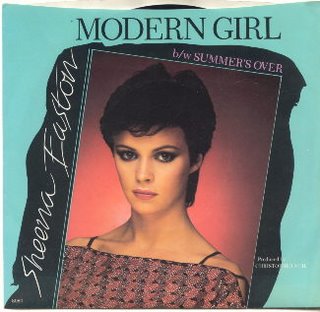
I must ashamedly admit that I was reminded of how quickly the culture changes by something pretty fluffy recently: stumbling across a Sheena Easton 80s video clip for the song "Modern Girl" on YouTube (this is my version of Scottish Enlightenment). It's no older than my childhood -- and wouldn't sound aesthetically out of place on the radio even today -- but the lyrics are in large part an assertion that Sheena can earn her own money and thus plan her own life, still a novel and tough-sounding stance at the time ("She don't build her world 'round no single man/ She's just gettin' by doin' what she can," etc.).

On a related note -- as foreseen by us capitalist types -- we've now reached the point where millennial females (at least in urban areas) out-earn males, and we simply do not have the political or cultural-analytical tropes on hand to say (without tumultuous repercussions) that

Sunday, March 20, 2011

Anarchy Everywhere Immediately! (A Cautious Explanation)

Am I rapidly changing my tune, after spending the past two decades trying to subtly nudge the culture rightward and the right punkward?  Yes, but I am not backpedaling or contradicting myself.  

Rather, I think (a) the urgency of the financial/spending crisis, (b) the heightened awareness of government-business collusion on both sides of the political spectrum, (c) the popularity of the (mostly) anti-big-government Tea Party movement (highly popular relative to the small hardcore libertarian movement in the decades preceding it), and (d) the diminished appearance of legitimacy of big governments around the world all combine to make this an appropriate time to switch to a more econ-focused and more urgent mode, even though a reserved gradualism, I swear, suits my temperament (not to mention Edmund Burke's) better in most circumstances.  

Also, the ever-diversifying media make gradual, subtle approaches passe, I fear.  The Whole Message must be conveyed in each sentence if anyone is to stop long enough to hear it.  The ship of state still turns slowly, but the ship of political discourse is becoming a jet ski among jet skis. 

•••

When it appeared that bland decades stretched before us in which to subtly steer the ship of state into one of two highly-popular channels, it made sense to focus on that tactic.  But if even the elderly are in the streets wielding signs painted with Rand slogans while wearing tricorn hats, things have changed.  I must change with the ever-more-fluid times as well, as must this blog (and its new-minted companion media modalities, products of this "twenty-first century" thing in which I have begun taking an interest). 

I will no longer assume there will be a right and left twenty years from now.  I am not confident there will be a stock market or welfare state as we know them, for good or ill.  There is no time left in which to mince words, then.  And no time to waste, over and over, on using political labels that confuse (and amuse) by meaning one thing this decade and the opposite thing the next (true of terms ranging from "anarchist" to "liberal" to "conservative," perhaps even "libertarian").  I will try to keep things more concrete and clear as we ride the changes together (hint: "property rights…taxes… spending cut…"). 

Tomorrow, a concrete reminder of how quickly things change (and tomorrow at Langan's at 7pm, a Manhattans Project gathering, where we can discuss it all). 

Saturday, March 19, 2011

OK, I think it is now fair for us to judge…

…both the conservatives and liberals by their adherence to libertarians' increasingly well-known standards, even in public discussions with the uninitiated, rather than to continue weighing in on which of the two larger factions is the lesser of two evils.  (The "not a dime's worth of difference" attitude seems pretty widely shared at this point, in part due to intervention in Libya.)

Time for the two big factions to catch up to us, even if -- admit it -- the GOP perhaps has a slight lead over the Dems at the moment by libertarian standards (a lead that will get bigger if people like the Republican Liberty Caucus, to whom I spoke last month, and Tea Party-affiliated politicians such as would-be Departments-abolisher Sen. Rand Paul have anything to say about it). 

The important thing is that I think we libertarian and Tea Party types are closer than ever before to being popularly regarded as the yardstick (prior to this point, I think that would've been a bit presumptuous).

As a corollary, if the GOP falters yet again, it's time to steer the Tea Partiers and everyone else who's willing into the Libertarian Party, strange and painful as that process would likely be -- and/or simply to start telling conservatives our ideology, not theirs, is the future of the GOP itself.  A party can have deeply divided factions, after all.  Maybe it should. 

(Note that I'm not saying libertarian principles just became correct yesterday -- they always were -- but rather that I think they have far more potential to mobilize voters and even politicians at this juncture than before, since in the past almost anyone being told to "switch to the LP," or "away from the old guard of the GOP," would merely have said "To the what?" and "You mean to the Democrats?" respectively.)

You have under two years to drink the tea deeply, GOP.   Then, I think, it's over -- not because we despair but because we may now be able to pull this off without you (and by "now" I mean…"eventually" -- but in this actual timeline/universe, which didn't always appear to be the case, if you follow me).  You'd better not nominate Huckabee.

P.S.  I predict it will be relatively easy for future students of law to remember the Lysander Spooner-like crackdown on private currency that ended with a conviction this week, since there are mnemonic devices aplenty in the tale of Bernard von NotHaus being convicted in Statesville for selling Liberty Dollars, in a case involving the Sheriff of Buncombe County.

Friday, March 18, 2011

Political Villains

An impending remake by David Fincher of the British political-intrigue series House of Cards could help, just a tiny bit.  It's as anti-government as Atlas Shrugged, in its way.

Imagine if Hollywood suddenly woke up to the fact that politicians and bureaucrats (not to mention a lot of pundits) are Machiavellian scum and thus provide plenty of fodder for drama.  And politician characters have plenty of time to scheme because, unlike business people, they do not have any productive work to do.  It's all drama and lies with politicians.

Thursday, March 17, 2011

New Wave Remembered, New Wave Betrayed (and Another Anti-Lady Gaga Note)

•One of the Todd-defenders, writing at Daily Caller after the C-SPAN2 thing last year, was Mark Gauvreau Judge, who is a music-savvy Catholic (mentioning him will have to count as my nod to St. Patrick’s Day).  He understands the subtle yet creepy difference between Madonna invoking religious (and sadomasochistic) imagery – which is troubling enough to begin with – and, worse, Lady Gaga invoking religious (and sadomasochistic) imagery.  He wrote a book last year on such things, and you can read a few brief, pivotal excerpts from his article on the specific Madonna-Gaga tension right here

In short, the decadent tail should not be wagging the impassioned dog or else real, dehumanizing nastiness has a tendency to ensue, even if it’s tricked out with imagery borrowed from more wholesome sources.

•But let us turn our minds instead to New Wave, starting with perhaps my favorite Miami Vice scene ever, the one that confirmed my status as a Peter Gabriel fan – with “Rhythm of the Heat” playing as a deranged arms dealer, a former colleague of Crockett who to this day I remember was named Evan (William Russ would make a good Joker), demonstrated what MAC-10s can do to mannequins – and why Vice looked and sounded cold and stylish enough to air three decades later without seeming hokey.  This version of the clip is dubbed into German, but in a weird way, that helps (“Zvitek!”). 

•My Favorite became: Secret History.  The band My Favorite, who I mentioned a long time ago, eventually parted ways with their lead singer but reorganized as the band Secret History, this time with two female singers, one the daughter of David Bowie guitarist Mick Ronson (whose widow not only created the Ziggy Stardust haircut but once cut the hair of my friend Michael Malice).  I’m pleased the reconfabulated band still shows New Wave influences.

•How about some real, vintage New Wave, though?

If the Fixx (who inspired the title of my March 14 blog entry) don't sound New Wave enough in their usual quasi-prog mode, how about their song "Liner," in which they sound a bit ABC, I think?  A nice balance of ominous-robotic and snooty, like much of the best British New Wave stuff (and very catchy, I think).

And if the Fixx sounding like ABC doesn't help, how about them sounding like Talking Heads?  (Dave Whitney thinks that one sounds a bit like this Talking Heads song -- with Robert Palmer on bongos.)

•Truth be told, although I’m always happy to hear New Wave, even as a kid in the 80s I never lived by New Wave alone.  No, I didn’t go through the metal-loving hair band phase that most of my contemporaries did.  What I had a special soft spot for at the time, really, was classic rock acts enduring into the New Wave era or making comebacks (and new bands, especially if fronted by women, that were more hard rock than effete-Brit).  Thus, the following twelve songs were all great sources of joy for me back in the day: